

Worldwide shipping
Find dealers worldwide
Clocks from the multiple winner of the Cuckoo Clock of the Year award
Payment with credit cards and Paypal
Related products
Description
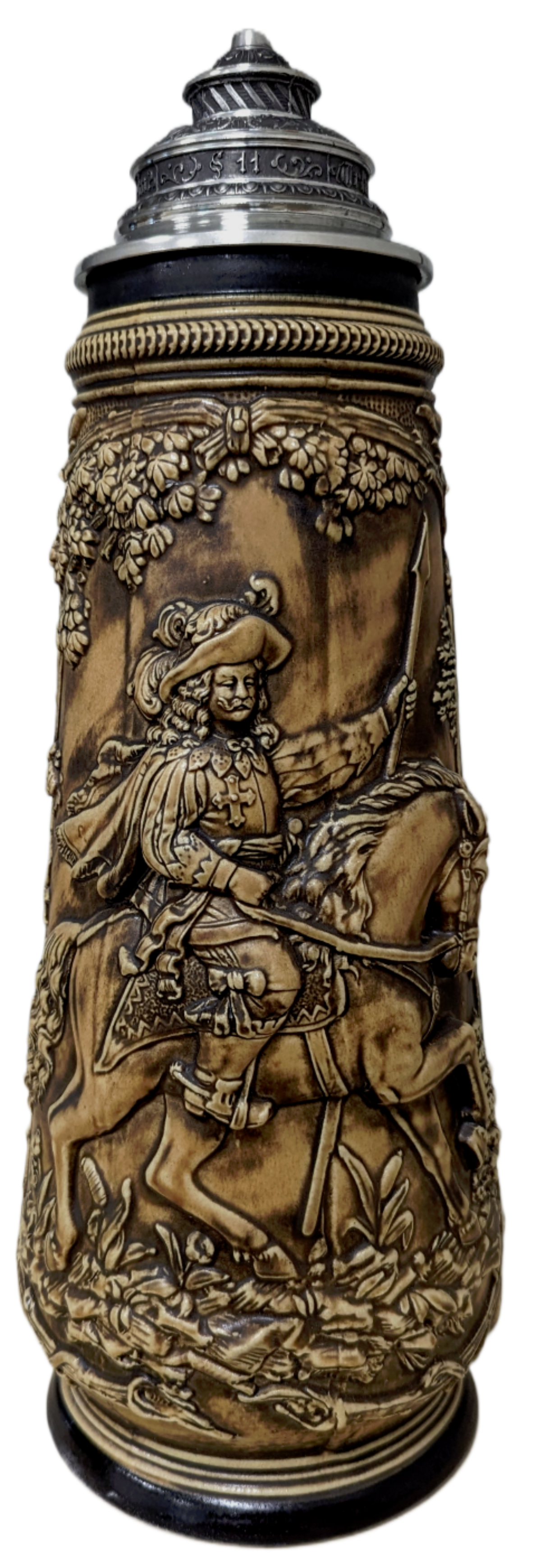
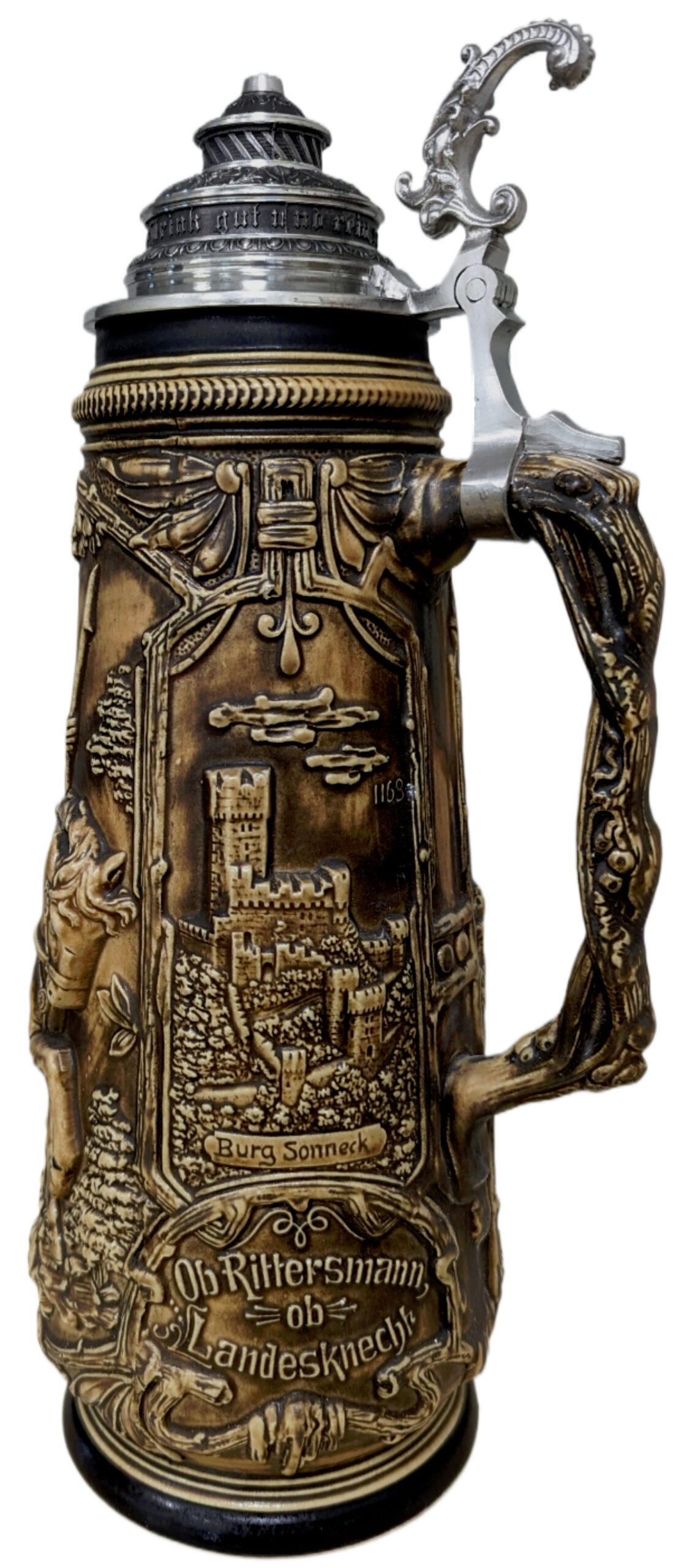
Product information “Landsknecht jug patina brown, 3 liters with magnificent pewter lid”
Here, a proud lansquenet on horseback is depicted in deep relief in detailed and strong, almost three-dimensional relief.
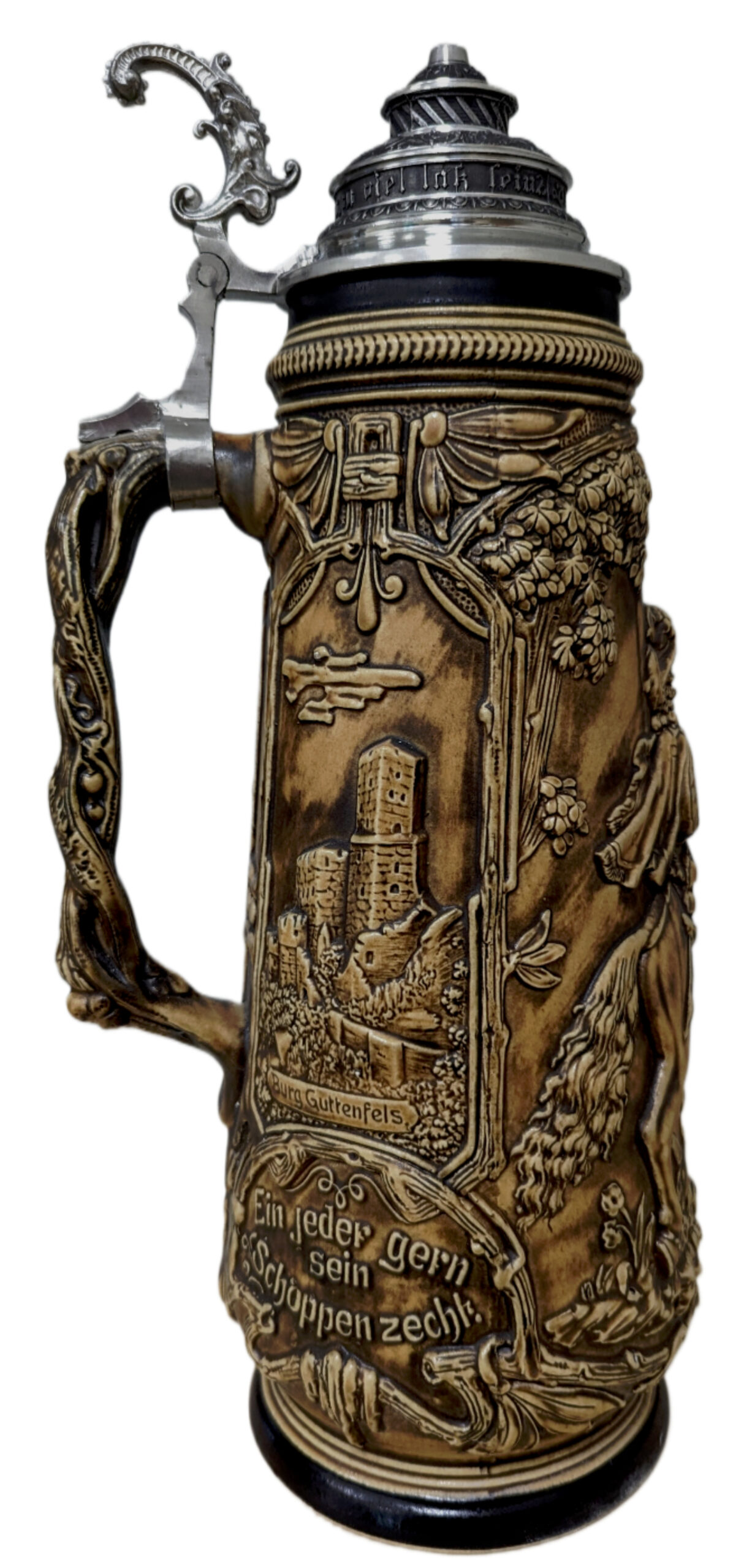
To the right and left of the handle are relief motifs of two castles that were built on the Rhine in the 12th and 13th centuries.
The term “Landsknecht” is made up of “Land” (country or region) and “Knecht” (servant) and thus means “servant of the land” or “servant of the region”.
Origins and development
- Foundation: The Landsknechte were founded by Emperor Maximilian I at the end of the 15th century. The need for a professional and effective infantry force led to their creation, partly inspired by the highly esteemed Swiss mercenaries.
Lifestyle and culture
- Striking appearance: Landsknechts were known for their striking and colorful clothing, often with slit sleeves and wide pants. This eye-catching clothing set them apart from other soldiers and became a symbol of their mercenary status.
- Code of Conduct: They followed a code of conduct that emphasized loyalty to their commanders and comrades. Despite their reputation for being restless and undisciplined off the battlefield, they were highly effective and disciplined in combat.
The Landsknechte were a distinctive and influential group of mercenaries who played a key role in the military history of late medieval and early modern Europe. Their contributions to the development of military tactics and their unique cultural identity have left a lasting legacy.
There is nothing to add to the saying: “Whether you are a knight or a farmhand – everyone likes to drink a glass of wine”. And the fact that people also like to drink a pint is just as independent of social status today as it was back then.
Gutenfels Castle:
Burg Gutenfels, also known as Burg Caub, is a historic castle in Kaub, Germany, with a rich and varied history
Early history and construction
- Construction: Gutenfels Castle was built around the year 1220. The exact construction period is not clearly documented, but it is assumed that it was built during the reign of the Counts of Falkenstein-Münzenberg. The castle was originally called “Burg Caub”.
- Name change: The name “Gutenfels” means “good rock” and became common over the centuries.
Middle Ages
- Strategic importance: The castle was of great strategic importance due to its location on the Rhine. It was part of the Palatinate’s defense system and played a key role in controlling shipping traffic on the Rhine and collecting customs duties.
- Counts Palatine of the Rhine: In the 13th century, the castle came into the possession of the Counts Palatine of the Rhine. It served as one of several important fortresses that secured the territory of the Electoral Palatinate.
14th to 16th century
- Extensions and reinforcements: Over the centuries, the castle was extended and reinforced several times in order to meet changing military requirements.
- Palatinate administration: The castle remained an important administrative center and residence for the Electoral Palatinate rulers for several centuries.
Thirty Years’ War
- War events: During the Thirty Years’ War (1618-1648), the castle was the scene of several military conflicts. It was conquered and occupied by various armies, which underlines its strategic importance during this conflict-ridden period.
Decline and decay
- Decline in strategic importance: In the late 17th and early 18th centuries, the castle lost its strategic importance due to developments in military technology and the political landscape.
- Decay: With the decline of its military importance, the castle was gradually abandoned and began to fall into disrepair.
19th and 20th century
- Romanticism and rediscovery: In the 19th century, Romanticism led to a renewed interest in medieval castles. Poets, painters and historians discovered the ruins of Gutenfels Castle and gave it a new cultural value.
- Restoration: In the second half of the 19th century and the early 20th century, restoration work was carried out to preserve and partially restore the castle.
Modern times
- Tourist attraction: Today, Gutenfels Castle is a well-preserved ruin and a popular tourist attraction. It offers an impressive view of the Rhine and the surrounding countryside and attracts many visitors.
- UNESCO World Heritage Site: The castle is part of the Upper Middle Rhine Valley, which was declared a UNESCO World Heritage Site in 2002. This recognition underlines the cultural and historical importance of the castle and its surroundings.
Capacity: Approx. 3 liters
D: 19 cm
Height: Approx. 42 cm
Additional information
| Bierkrüge | Beer mugs |
|---|